Acrochordiceras
Acrochordiceras is a genus of Middle Triassic ammonoid cephalopods belonging to the ceratitid family Acrochordiceratidae, included in the superfamily Ceratitoidea.

Kent G. Budge · CC BY-SA 4.0 · via Wikipedia/Commons. May be a photograph of a specimen, or an artist’s reconstruction — an interpretation of a skeleton, since colour and soft tissue are almost never preserved.
On record
Recorded, not inferred- Sits inside
- AcrochordiceratidaePBDB
- Diet
- carnivorePBDB, for Ceratitida
- Life habit
- nektonicPBDB, for Ceratitida
- Motility
- actively mobilePBDB, for Ceratitida
- Vision
- well-developedPBDB, for Cephalopoda
- Environment
- marinePBDB, for Cephalopoda
Time the record covers
At least 5.1 million years on record.
The record covers at least 248.6 Mya to 243.43 Mya. No occurrence read is dated outside 250.8 Mya to 227.3 Mya.
232 occurrences of Acrochordiceras on record, most of them in the Middle Triassic. Bar height is expected occurrences, not a count: each fossil is spread across the span it is dated to, so a tall narrow bar means tight dating and a low wide one means loose.
When
232 occurrences- Early Triassicunder 1%
- Middle Triassic96%
- Late Triassic3%
These are dates about fossils, not the animal: the record can only begin after it arose and end before it died out, so either end may reach further. Shares are expected occurrences: a fossil dated to a span is counted partly in each period it straddles. More on what this infers.
Found in
25 formations
- Favret Formation · Star Peak Group22
- Prida Formation · Star Peak Group17
- Gutenstein Formation12
- Acheshbok Formation6
- Felsoörs Formation4
- Felsõörs Formation4
Loading coastlines…
The named rock units Acrochordiceras has been recovered from, largest first. Drawn where the rock is now, not where it formed. One further formation holds fewer occurrences and is not listed. 132 occurrences have no formation on record, which is common for older literature.
Acrochordiceras and its relatives
Middle TriassicWhere Acrochordiceras and its relatives were recorded in the Middle Triassic.
Found in the same rock
657 taxa- Kocaelia toulai18 sites
- Leiophyllites confucii16 sites
- Austriellula kavakensis15 sites
- Aghdarbandites ismidicus14 sites
- Proarcestes bramantei13 sites
- Paraceratites trinodosus11 sites
- Balatonites balatonicus10 sites
- Ptychites10 sites
- Balatonites9 sites
- Discoptychites pauli9 sites
- Gymnites toulai9 sites
- Holcorhynchella edhemi9 sites
- Monophyllites wengensis9 sites
- Proarcestes escheri9 sites
- Ptychomentzelia propontica9 sites
- Balatonites ottonis8 sites
- Flexoptychites flexuosus8 sites
- Leiophyllites suessi8 sites
- Nevadisculites taylori8 sites
- Norites gondola8 sites
- Phyllocladiscites proponticus8 sites
- Ptychites opulentus8 sites
- Sturia sansovinii8 sites
- Gymnites7 sites
The Paleobiology Database records 164 sites for Acrochordiceras, and this reads all of them. The number is how many of those sites it was catalogued from too. The 24 sharing the most are listed.
This is not a list of everything alive at the time. It is only what has come out of the same ground as this animal and been written down.
Entered from
37 references- Revision of the genus Acrochordiceras Hyatt, 1877 (Ammonoidea, Middle Triassic): morphology, biometry, biostratigraphy, and intra-specific variability63
- Anisian ammonites from Gebze area (Kokaeli Peninsula, Turkey)57
- Die Trias von Bithynien (Anatolien)13
- Catalogue of Fossil Cephalopoda in the British Museum (Natural History), Part IV, The Ammonoidea of the Trias11
- The Pelsonian ammonoid fauna of the Balaton Highland8
- Middle Triassic Molluscan Fossils of Biostratigraphic Significance from the Humboldt Range, Northwestern Nevada8
- The Fauna of the Himalayan Muschelkalk7
- Noetlingites strombecki (Griepenkerl, 1860) and the stratigraphical position of the ammonite-faunas of Großreifling (Anisian, Styria/Austria)6
- Triassic ammonoids of the northwest Caucasus6
- Geologie der Umgebung von Sarajevo5
- Die Cephalopoden der Mediterranen Triasprovinz5
- So-called Middle Triassic "Claraia" (Bivalvia) from Guangxi, south China4
Each of the 232 occurrences read was entered from one of these publications, ordered by how many each accounts for. This is not a search for papers mentioning the name. 25 further references are not listed. Entries link to doi.org where the Paleobiology Database holds an identifier, and to its own record where it does not. Relayed as the Paleobiology Database holds them, not checked against what they resolve to.
Media and terms
Media content1
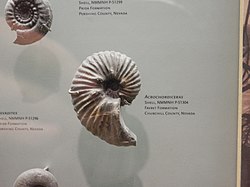
Picture of Acrochordiceras
- Source
- Wikipedia/Commons
- Credit
- Kent G. Budge
- Licence
- CC BY-SA 4.0
- Commercial use
- the licence allows it
No 3D scan was found. Smithsonian Open Access, MorphoSource and Sketchfab were all searched.
The description on this site
- Licence
- CC BY-SA 4.0
This is what the site found, which is not the same as what exists.
Keep going
What may have been alongside itAcrochordiceratidae through timeFormations of the Middle TriassicThe world it lived on
Occurrence data from the Paleobiology Database, CC BY 4.0. (Hyatt 1877)